New Graceada Partners Research Measures the Inland West as One Economy – and Finds It Passed the Southeast on Income
MODESTO, Calif., Sept. 2, 2026
Press Release Disclaimer: This is a press release distributed through the XPR Media network. It has not been independently verified by our newsroom.

New Graceada Partners Research Measures the Inland West as One Economy – and Finds It Passed the Southeast on Income
PR Newswire
MODESTO, Calif., Sept. 2, 2026
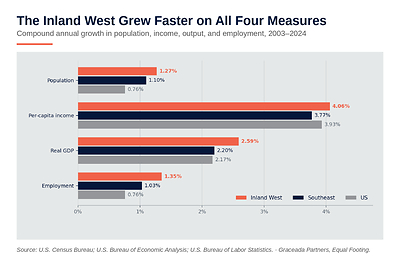
A 47-million-person economy, larger than any single state, is largely absent from regional data because state lines divide it. Measured whole on federal data over 21 years, it matches or leads the high-growth Southeast on population, income, output, and employment growth.
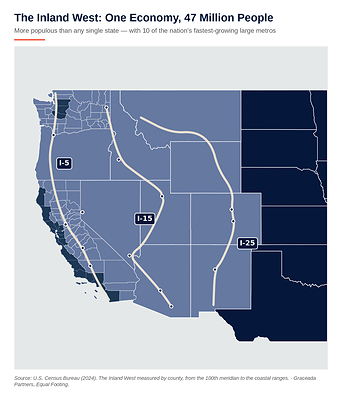
MODESTO, Calif., Sept. 2, 2026 /PRNewswire/ — Graceada Partners today released Equal Footing: The Inland West and the Southeast, a research paper that does something the market has not: it measures the Inland West as a single economy rather than as fragments of eleven states. Defined from the 100th meridian to the coastal ranges, the region holds roughly 47 million residents – more than any single state – and includes ten of the country’s fastest-growing large metros including Phoenix, Denver, Las Vegas, Salt Lake City, Sacramento, and Boise.
The region does not appear in most regional data because it is carved up by state lines drawn without regard to how its economy runs. Inland California is averaged into San Francisco; Spokane into Seattle. On the affordability, age, migration, and industry measures that drive housing and logistics demand, Fresno, Bakersfield, and Spokane behave like Boise and Phoenix, not like the coastal metros they are reported inside.
Download the full paper, the underlying data model, and a methodology summary at graceadapartners.com/equalfooting.
Measured Again the Southeast
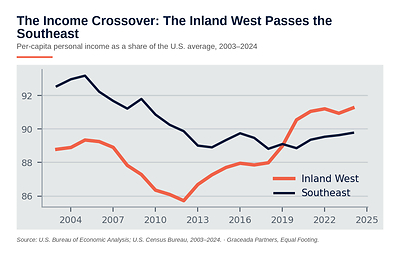
Measured against the high-growth Southeast on the same federal data over the same 21 years, the Inland West matches or leads on population, income, output, and employment growth. The single most striking finding is a crossover in per-capita income relative to the national average. In 2003 the Southeast sat closer to the U.S. average (92.6 percent) than the Inland West (88.8 percent). By 2024 the two had traded places with the Inland West converging upward and the Southeast drifting down relative to the nation.
Over the full period the Inland West added about 5.4 million jobs to the Southeast’s 4.4 million – roughly a million more, from a region with 1.6 million fewer residents. The lead is not a relic of the 2000s: across the last five years (2019–2024) the Inland West grew faster on real output and employment, and it out-grew the Southeast in 17 of 21 years on population and 16 of 21 on real output.
“A 47-million-person economy growing faster than the consensus region shouldn’t be invisible to institutional capital. It’s been overlooked not because the fundamentals are weak, but because no one had measured it whole,” said Ryan Swehla, President and co-founder of Graceada Partners.
About Graceada Partners
Graceada Partners is an institutional real estate investment manager that invests in multifamily and multi-tenant industrial property across the Inland West. Graceada manages nearly $1 billion in real estate assets with a vertically integrated team of 70 professionals and 18 years of operating history. For more information, visit www.graceadapartners.com.
The research is provided for informational purposes and is not investment advice or an offer of any security.
Figures: Equal Footing, 2003–2024. Sources: U.S. Census Bureau, U.S. Bureau of Economic Analysis, U.S. Bureau of Labor Statistics.

 View original content to download multimedia:https://www.prnewswire.com/news-releases/new-graceada-partners-research-measures-the-inland-west-as-one-economy–and-finds-it-passed-the-southeast-on-income-302867881.html
SOURCE Graceada Partners