
Aggregated visual constraints sharpen visual-inertial navigation startup
FAYETTEVILLE, GA, UNITED STATES, October 16, 2026 /EINPresswire.com/ -- A new decoupled initialization framework,
Press Release Disclaimer: This is a press release distributed through the XPR Media network. It has not been independently verified by our newsroom.
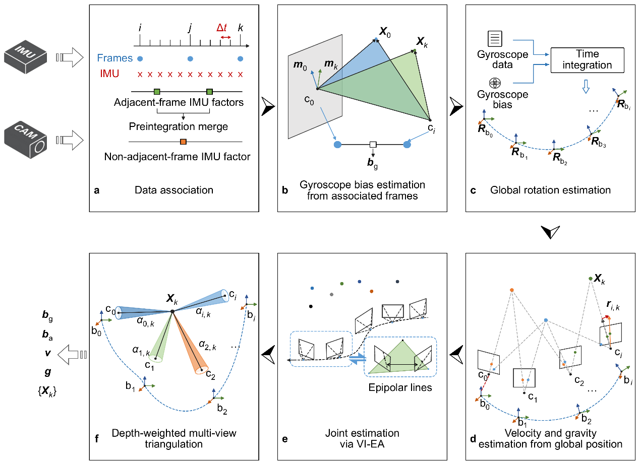

FAYETTEVILLE, GA, UNITED STATES, October 16, 2026 /EINPresswire.com/ — A new decoupled initialization framework, Aggregated Visual Constraints for decoupled initialization in visual-inertial navigation (AVC-Init), tackles a key challenge in visual-inertial odometry (VIO): reliable startup with short observation windows and noisy visual measurements.The method compresses feature-based geometric constraints into compact coplanarity-based aggregated visual constraints (AVC), estimates gyroscope bias from long-baseline keyframe pairs, and recovers velocity and gravity through global-position constraints. A landmark-free visual-inertial epipolar adjustment (VI-EA) stage then refines the states, followed by depth-weighted multi-view triangulation to recover landmarks. By avoiding high-dimensional 3D landmark variables during joint refinement, the approach aims to improve initialization success, accuracy, and efficiency for visual-inertial navigation systems.
Visual-inertial odometry (VIO) fuses cameras and inertial measurement units (IMUs) for robust pose estimation, but initialization remains difficult. Traditional methods often assume a stationary start or rely on visual structure-from-motion (SfM), which can fail under weak texture, motion blur, or insufficient parallax. Tightly coupled methods jointly optimize scale, velocity, gravity, feature depth, and IMU biases, but the problem is highly nonlinear and sensitive to initial values and motion excitation. Existing decoupled approaches reduce complexity, while structureless approaches remove explicit 3D landmarks from the optimization state; however, visual residual dimensions can still grow with the number of features. Based on these challenges, in-depth research is needed on compact, stable, and efficient visual-inertial initialization.
Researchers at the National University of Defense Technology in China developed aggregated visual constraints (AVC)-Init, a decoupled visual-inertial initialization framework. Published (DOI: 10.1186/s43020-026-00224-w) on 7 October 2026 in Satellite Navigation, the study integrates long-baseline aggregated rotation constraints, preintegration merging, global-position estimation, and landmark-free joint refinement. The framework estimates gyroscope bias, velocity, gravity, and scale in stages, performs landmark-free joint refinement, and then re-triangulates 3D landmarks. It was tested on simulated data, EuRoC, TUM-VI, and a self-collected outdoor dataset. It reports higher success rates and lower errors than tested baselines in most settings.
AVC-Init follows a staged, decoupled pipeline. First, it estimates gyroscope bias from aggregated rotational constraints between co-visible keyframe pairs. Instead of using only adjacent frames, it selects long-baseline pairs to increase parallax and reduce sensitivity to pixel noise. Preintegration merging reuses inertial information across non-adjacent pairs, aligning visual constraints with corresponding inertial transitions without reintegrating raw IMU data. Second, the framework estimates initial velocity and gravity using global-position (GP) constraints. It offers two variants: a tightly coupled GP estimator (GP-T) and a loosely coupled GP estimator (GP-L). GP-T optimizes visual residuals and IMU preintegration in one nonlinear problem, while GP-L first obtains scale-ambiguous camera positions and then aligns them with inertial constraints. Third, visual-inertial epipolar adjustment (VI-EA) performs joint refinement using signed square-root Sampson residuals at the frame-pair level. VI-EA removes 3D landmarks from the optimization state, enabling low-dimensional refinement while preserving geometric information. Finally, depth-weighted multi-view triangulation recovers landmarks from refined poses. Experiments show higher success rates and lower errors than tested baselines in most settings. AVC-Init with GP-T (AVC-T) reached 91.13% success on EuRoC controlled windows, compared with 81.20% for a decoupled rotation-translation (DRT) baseline, while VI-EA achieved accuracy comparable to visual-inertial bundle adjustment (VI-BA) with lower runtime.
The work addresses a practical gap in visual-inertial navigation: initialization often determines whether a system converges reliably, yet existing methods can be fragile or computationally expensive. AVC-Init keeps joint refinement low-dimensional by removing landmark variables, while using long-baseline visual information to improve gyroscope bias estimation. This design helps maintain accuracy under short initialization windows and noisy visual observations, although adequate motion excitation and persistent visual overlap remain important. The framework has been integrated into existing visual-inertial simultaneous localization and mapping (SLAM) systems.
AVC-Init could support autonomous vehicles, drones, augmented and virtual reality (AR/VR), and embodied intelligence, where fast and reliable startup is essential. Its modular design allows integration into visual-inertial SLAM systems such as ORB-SLAM3, Kimera2, and OKVIS2-X. In outdoor tests, integrating AVC-Init reduced mean absolute trajectory error (ATE) for ORB-SLAM3 and Kimera2 on several segments, with the largest improvement for Kimera2. The method may also benefit resource-constrained platforms because VI-EA avoids high-dimensional landmark variables and caches observation terms. However, performance still depends on motion excitation, visual overlap, and accurate camera-IMU calibration and synchronization. Future work is expected to address stronger degeneracy and further runtime optimization.
References
DOI
10.1186/s43020-026-00224-w
Original Source URL
https://doi.org/10.1186/s43020-026-00224-w
Lucy Wang
BioDesign Research
email us here
Legal Disclaimer:
EIN Presswire provides this news content “as is” without warranty of any kind. We do not accept any responsibility or liability
for the accuracy, content, images, videos, licenses, completeness, legality, or reliability of the information contained in this
article. If you have any complaints or copyright issues related to this article, kindly contact the author above.

Media gallery

